Fire recovery requires immediate mitigation because smoke odor is particulate matter and volatile chemical gas driven deep into porous substrates by heat pressure. In Los Angeles, the marine layer along Venice and…
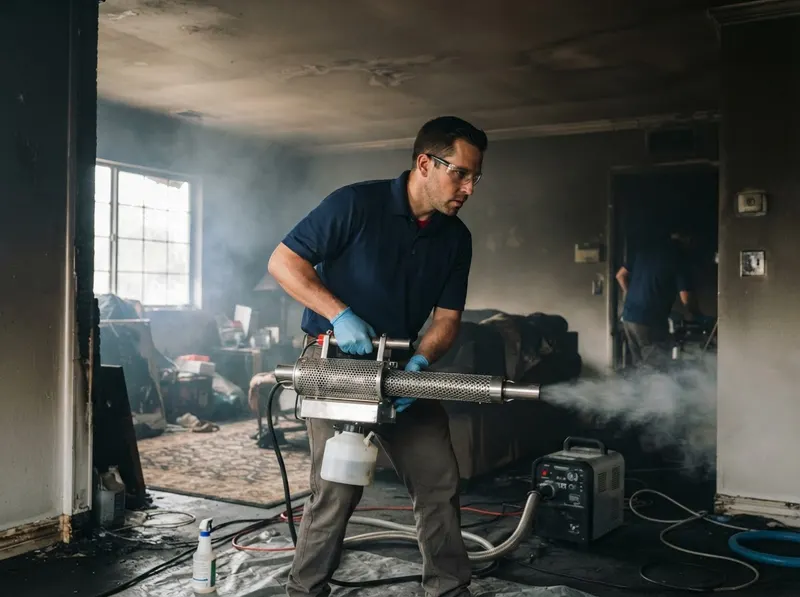
Fire recovery requires immediate mitigation because smoke odor is particulate matter and volatile chemical gas driven deep into porous substrates by heat pressure. In Los Angeles, the marine layer along Venice and Pacific Palisades increases relative humidity, which locks combustion gases into wallboard and acoustic ceilings. Inland heat in Woodland Hills and Sherman Oaks causes porous wood framing to expand and absorb volatile soot aerosols. Thermal fogging utilizes a solvent-based chemical deodorant heated into micro-droplets ranging from 0.5 to 2 microns in diameter. These vaporized droplets track the identical pathways of pressurized fire smoke, entering microscopic fissures in concrete, lath, and framing lumber to neutralize acidic residues rather than masking them with surface perfumes.
Hydroxyl generation operates on atmospheric moisture, using targeted ultraviolet optics (185 nm to 254 nm wavelengths) to split ambient water vapor into free-radical hydroxyl molecules (·OH). These hydroxyl radicals dismantle the carbon bonds of sulfur, nitrogen, and polycyclic aromatic hydrocarbons on contact. Unlike high-concentration ozone, hydroxyl treatments run safely in structures containing natural rubber, vinyl, and ongoing recovery crews, eliminating displacement delays during urgent stabilization. In dense urban structures across Koreatown and Silver Lake, multi-unit duct systems demand active hydroxyl scrubbing to halt cross-unit contamination without forcing full building evacuations.
Selecting the correct methodology depends on material porosity and site occupancy. Thermal fogging provides rapid, deep stabilization in unpopulated framing and subfloors during the early demolition and soot-removal phases. Hydroxyl neutralization fits occupied restoration zones, finished drywall spaces in historic Los Feliz or Mount Washington residences, and sensitive content recovery in Brentwood estates where rubber seals, oil paintings, and fine textiles cannot tolerate harsher oxidation methods. Every project begins with an on-site physical soot-depth measurement to calculate air-exchange volumes and vapor runtimes, followed by itemized Xactimate estimates delivered directly to insurance carriers.
Every job gets a firm, written price after a free on-site visit.
Tell us about your thermal fogging and hydroxyl odor neutralization job in los angeles and we'll send a clear, written quote, usually the same day.
 First Fire Damage Restoration