Charred dimensional lumber and heavy timber framing require precise carbon removal after an extinguished structure fire to preserve structural load capacity without cross-contaminating living spaces. In Los Angeles…
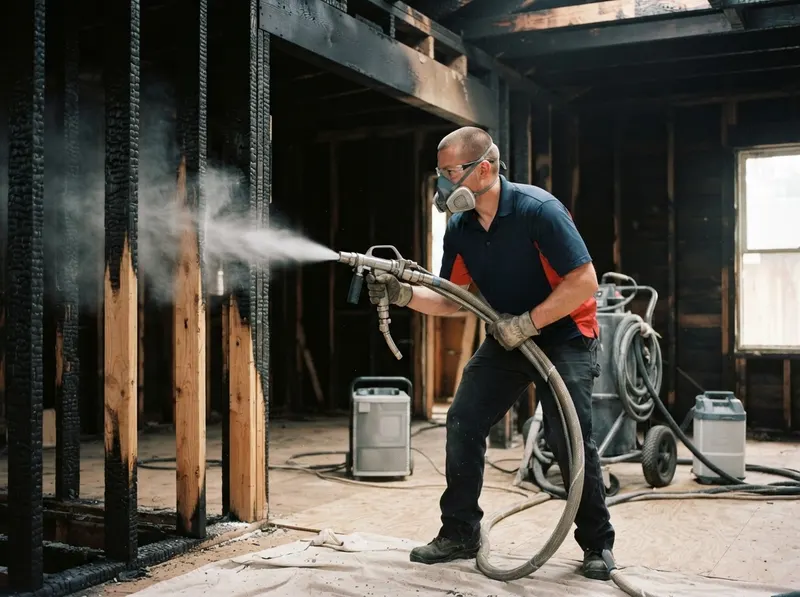
Charred dimensional lumber and heavy timber framing require precise carbon removal after an extinguished structure fire to preserve structural load capacity without cross-contaminating living spaces. In Los Angeles framing fires, municipal suppression efforts leave framing timber saturated with moisture beneath deeply baked exterior char. Manual scraping with wire brushes frequently forces fine carcinogenic soot particulates deeper into open wood pores, while traditional abrasive blasting using sand or soda leaves behind hundreds of pounds of contaminated blast media that must be extracted from wall cavities and subfloors. Industrial dry ice blasting accelerates solid carbon dioxide micro-pellets via high-pressure air hoses against charred framing members. Upon impact, the dry ice sublimates instantly from a solid to a gas, expanding nearly 800 times in volume beneath the char layer to fracture the brittle carbon away from dense, salvageable wood fibers without generating secondary blast residue.
Selecting dry ice blasting fits situations where structural framing retains load-bearing viability beneath a superficial char layer of 1/16 to 1/4 inch, avoiding the extensive financial expense of complete timber tear-out and rebuilding. The trade-off is the necessity of rigorous continuous air management: dry ice sublimation introduces concentrated carbon dioxide gas into confined environments, requiring dedicated negative-pressure HEPA air extraction units venting outside the structure. If framing char exceeds structural engineering tolerances, typically when wood cross-sections are degraded beyond critical load capacity as confirmed by a structural engineer, timber sistering or beam replacement is required instead of surface blasting. For historic wood framing across hillside residences in Los Feliz and Mount Washington, dry ice preserves original lumber dimensions while stripping out volatile organic compounds and deep-seated pyrolytic odor compounds.
Operational logistics vary across regional microclimates and architectural layouts throughout the Los Angeles basin. In high-density street grids such as Koreatown or Silver Lake, staging industrial air compressors and containment trucks requires specific exterior umbilical routing through windows or service entries. Properties situated along the coastal humidity corridors of Venice and Pacific Palisades frequently hold elevated framing moisture content, where dry ice blasting eliminates char cleanly without driving additional water into wet Douglas fir studs. Farther inland, framing in Woodland Hills or Sherman Oaks often dries rapidly under valley heat, creating powdery, friable soot layers that require immediate negative-air containment zones to stop airborne migration into clean building envelopes. First Fire Damage Restoration manages this stabilization workflow with verified documentation aligned with IICRC S520 and S700 standards for direct review by carrier adjusters.
Every job gets a firm, written price after a free on-site visit.
Tell us about your industrial dry ice blasting for heavy framing char job in los angeles and we'll send a clear, written quote, usually the same day.
 First Fire Damage Restoration